The purpose of this article is to help sport shooters choose the right scope and mount for different shooting disciplines such as precision shooting, long-range shooting (LRS) and extreme long-range shooting (ELR).
It examines the role of the scope in a weapon-scope-shooter system, reviews the elements that make up a scope suitable for the mentioned shooting disciplines, and discusses the essential choices of first or second focal plane reticle and angle measurement system.
Using these foundations, the article outlines the essential criteria for choosing a scope suitable for precision shooting, LRS, and ELR, such as magnification, for instance, as well as the criteria for choosing a scope mounting system, since such a system is essential for the scope to fulfill its mission.
Finally, the article presents the various precision shooting, LRS, and ELR rifle scopes offered by Schmidt & Bender, a brand selected by PGM Précision for their high quality of manufacturing and the outstanding performance of their products.
Its conclusion consists of a summary table of advice that can be given to a precision sport shooter or an intermediate or an expert LRS or ELR shooter taking part in competitions.
This article is intended as a guide for a wide range of uses, including LRS on gongs for leisure or competition, extreme long range (ELR) shooting, F-Class, Precision Rifle Shooting (PRS), Benchrest, etc. It summarizes the recommendations and advice that PGM Précision can offer based on its experience and history, but it is not intended to represent the sum of available knowledge on precision shooting scopes and their mount, or to be prescriptive in nature: each shooter is free to make their own choice based on their personal criteria, aided by the information below.

Rifle scopes for precision shooting, LRS and ELR play an essential role in the weapon-shooter system because they provide the visual and technical link between the shooter and the target. Their main function is to provide a magnified, clear, and stable image of the target, while allowing for precise elevation and windage adjustments to compensate for the effects of gravity, distance, and wind. Thanks to the graduated reticle, the shooter can estimate distances, correct the trajectory of the projectile, and repeat shots consistently.
Integrated into the weapon-ammunition-shooter system, precision and long-range shooting scopes directly contribute to the accuracy, consistency, and effectiveness of shooting, transforming the mechanical capabilities of the weapon and the skills of the shooter into a coherent and high-performance setup.
Thus, in the disciplines of precision shooting, LRS, and ELR, the rifle scope is not a simple accessory but a central element of the weapon-ammunition-shooter system. Its ability to withstand the stresses of this type of shooting and to fulfill its essential functions depends directly on the objectives for which it was built, the quality of its mechanical and optical manufacturing, and its suitability for the caliber.
It is therefore essential for the sport shooter to have a precise knowledge of the components that make up their precision rifle scope and the essential factors to consider when choosing one.
This section describes the main components of the rifle scope, along with their characteristics and functions.
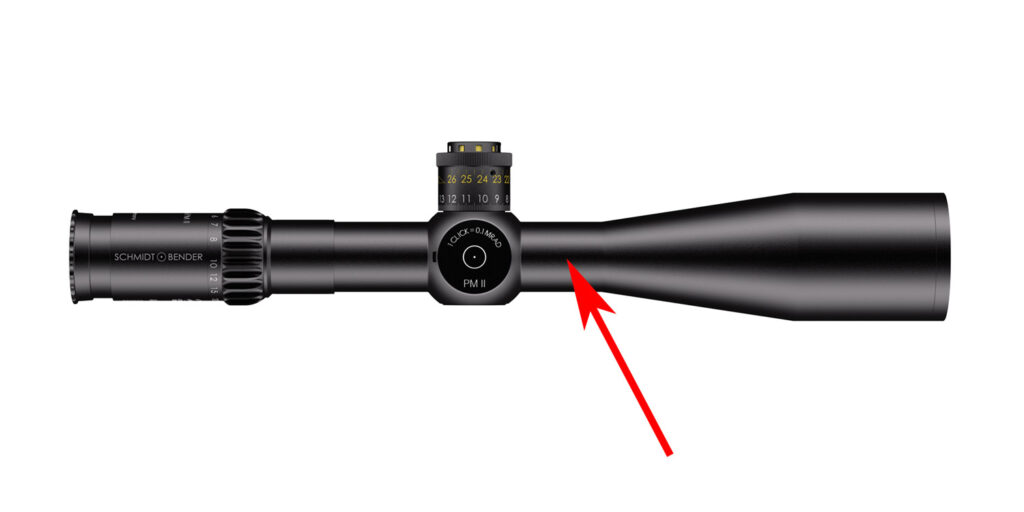
This cylindrical tube contains the optical and mechanical system. Its diameter varies from 30 to 34 mm on high-end optics (35 or 36 mm in some cases) because the larger it is, the easier it is for the optics to transmit light, and the greater the range of adjustments it allows.
As with other components of the scope, the quality of construction and the metal used are essential. The energy released when the firing pin strikes the primer of the cartridge is considerable (3,000 to 15,000 joules depending on the caliber). It produces acceleration and recoil that must be absorbed by the mount and the body of the scope, deforming them and forcing them to return to their original shape and position perfectly at each shot.
The quality of the scope’s construction and mount cannot therefore be compromised, and it must be adapted to the caliber of the rifle to ensure consistent, long-lasting performance.
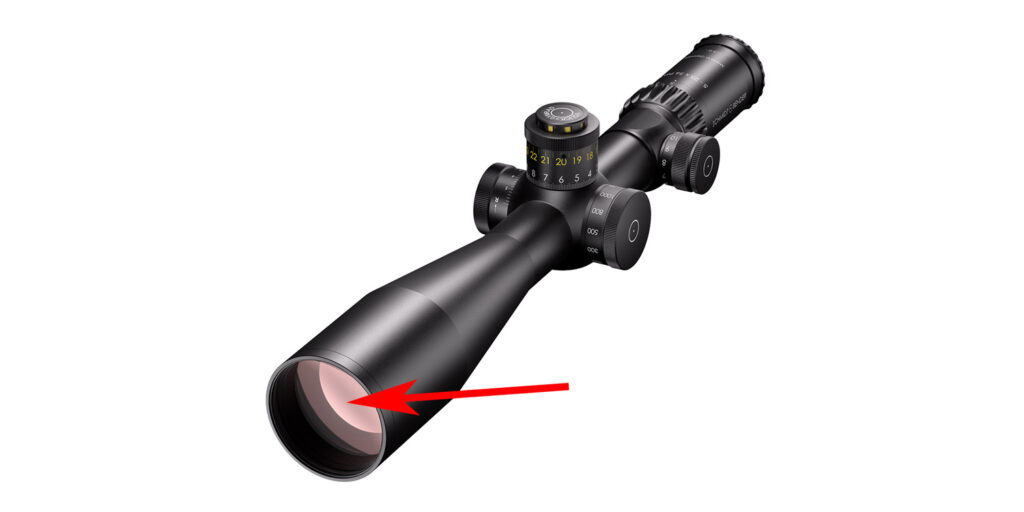
This is the lens located at the front of the rifle scope. Its diameter generally varies from 50 mm to 56 mm for the most high-performance models.
Just like the body of the scope, the larger the diameter of the lens, the better the light transmission and image quality, provided that the optics are of high quality and have been specially coated to improve transmission, detail rendering, and contrast. The trade-off for these advantages is that the scope becomes heavier and more expensive.
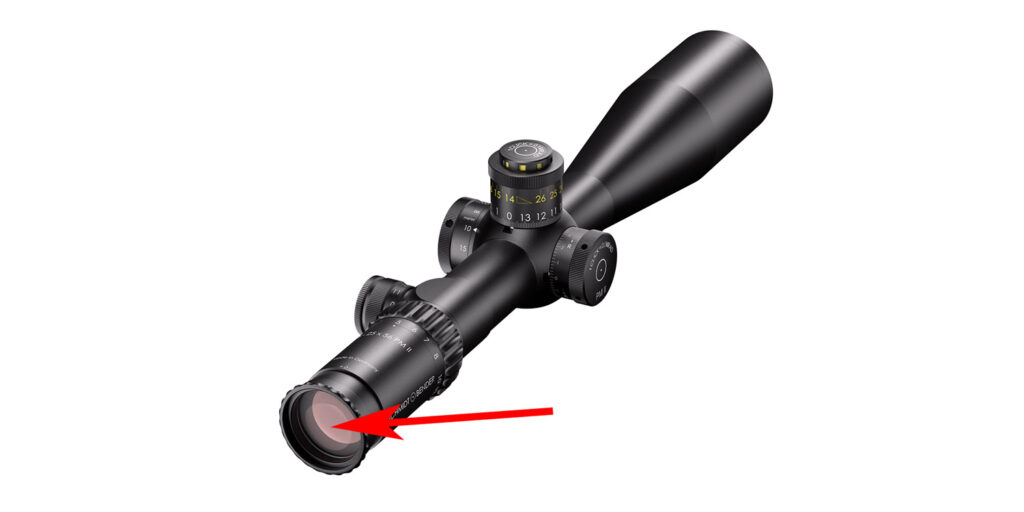
It corresponds to the rear part of the rifle scope, on the side of the eye.
Points to consider for the ocular lens:
The reticle is the pattern engraved or projected into the field of view of the rifle scope.
It fulfils the following essential functions:
A reticle can be simple or classic cross-shaped, appearing as a thin horizontal and vertical cross. This type of reticle has the advantage of being easy to read, but it is not well suited to precision shooting or long-range shooting because it does not provide information for measuring distances or dimensions.
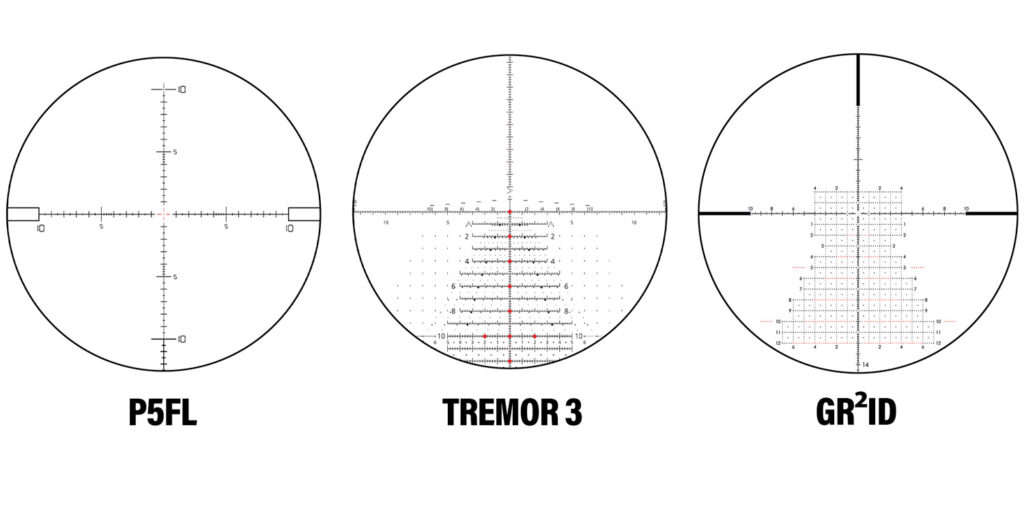
The reticles commonly used in these disciplines incorporate an angle and dimension measurement system such as MRAD, MIL, or MOA. Examples of models include:
Some shooters employ more sophisticated reticles that provide additional information and measurements. These come in several forms:
These reticles can be suitable to shooters who practice without a spotter and who have no difficulty seeing their impacts behind the “Christmas tree” or grid.
It should also be noted that most high-end rifle scopes allow for reticle illumination to facilitate shooting in suboptimal lighting conditions or on targets with dark centers.
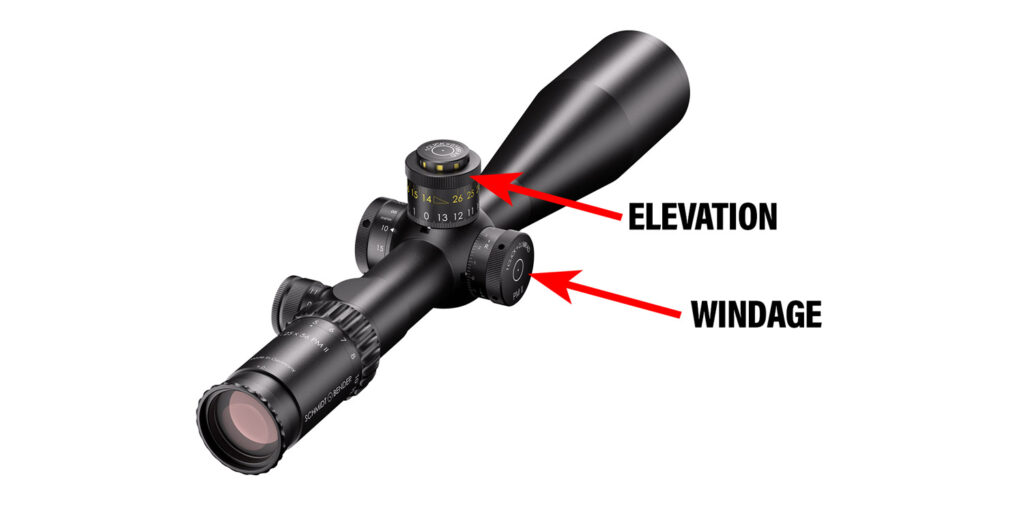
These rotating dials located on the top and side of the scope allow to adjust elevation (up/down, also known as “rise”) and windage (left/right), respectively. Inside the scope body, the turrets act on the inner tube, which moves while being held in place by a return spring, allowing for constant tension and high-precision adjustments.
For ease of use, it is important that these settings are precise with audible and tactile clicks.
One point to pay attention to is the direction of rotation of the turrets. In the Anglo-Saxon world, turrets tend to be CCW or “Counter Clock Wise.” This means that to add elevation, for example, you must turn the elevation turret counterclockwise, and vice versa to remove it.
In a European context, shooters tend to prefer CW or “Clock Wise” turrets, which must be turned clockwise to add elevation.
There is no ideal or perfect choice, but this is something to be aware of, especially for shooters who already have a rifle scope and want to maintain their habits when switching from one model to another.
On all high-quality rifle scopes, the turrets can be unlocked to allow for effective zeroing (the process of aligning the scope’s reticle with the points of impact at a given distance, often 100 m).
Rifle scopes of the quality produced by Schmidt & Bender also feature a system called “zero stop,” which is hidden in the elevation turret and provides a stop to prevent the scope from being lowered below its initial setting.
This feature is useful for shooters who regularly adjust their settings when shooting at multiple distances, as it allows them to quickly return to a predetermined zero after adjusting the elevation, ensuring consistent and accurate shots.
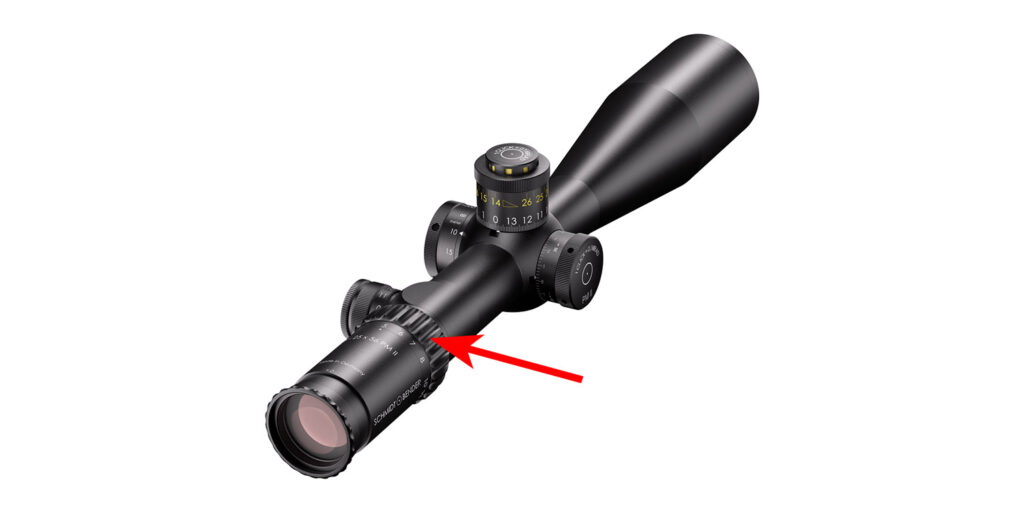
Located in front of the ocular lens, it allows changing the zoom magnification level. However, maximum magnification is not necessarily ideal. In a first focal plane scope, the engravings can obscure all or part of a small or distant target. Moreover, the higher the magnification, the finer the aiming… but the more sensitive it is to movement (a phenomenon exacerbated in the case of a “Christmas tree” or grid reticle).
These elements provide a better understanding of the nomenclature used by most manufacturers of precision rifle scopes. The first two digits correspond to the minimum and maximum magnification levels, and the last digit corresponds to the diameter of the lens in millimeters.
For example, the Schmidt & Bender 5-25×56 PM II LP Tremor3TM scope is a scope with a zoom magnification ranging from 5x to 25x, a 56 mm objective lens, and a Tremor3TM “Christmas tree” reticle.
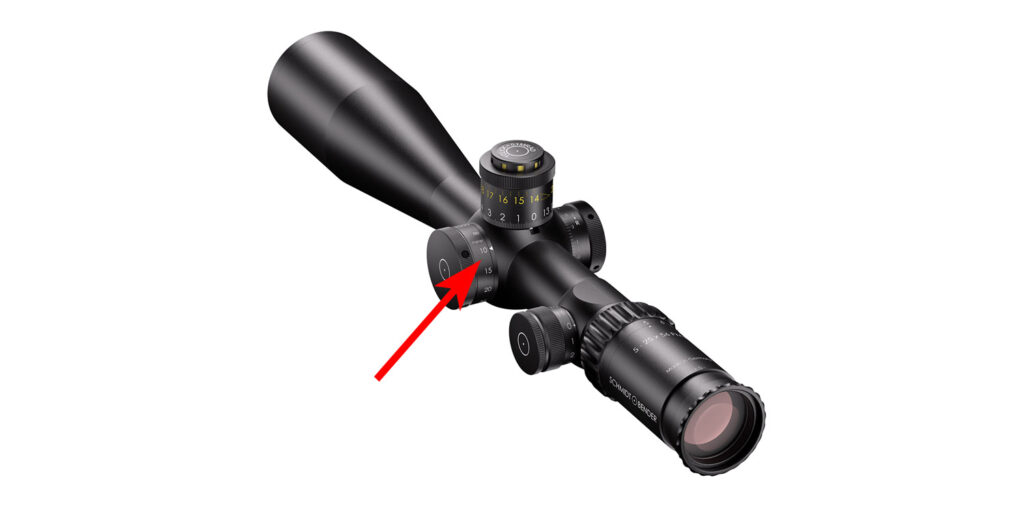
Parallax is an optical error that occurs when a shooter aims without looking at the perfect center of the scope’s line of sight. It causes a slight shift between the focal plane of the target and the focal plane of the reticle, resulting in shots that miss the target. This error increases with the magnification of the scope.
Parallax adjustment is usually done using a side dial (or a ring on the lens or around the elevation turret in some cases) that aligns these focal planes and eliminates the error. During this operation, the shooters see the sharpness of their images improve to a point where sharpness is independent of the position of the eye in front of the eyepiece. This adjustment is essential for precision shooting, long range shooting, and extreme long range.
In high-quality scopes such as those produced by Schmidt & Bender, they are made of multi-coated glass to ensure better brightness, high contrast, and reduced glare. Those related to the zoom function are integrated into an internal tube.
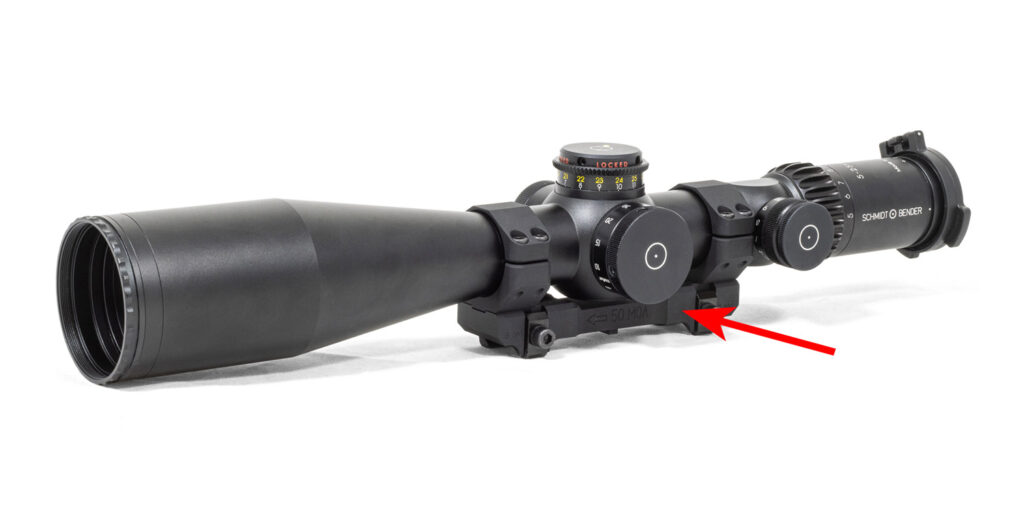
It consists of a set of collars and a rail or base that secures the scope to the weapon. It is essential that this mount is perfectly aligned and secure in order to maintain zeroing throughout firing.
Given its importance, this topic is discussed in a separate section later in this article.
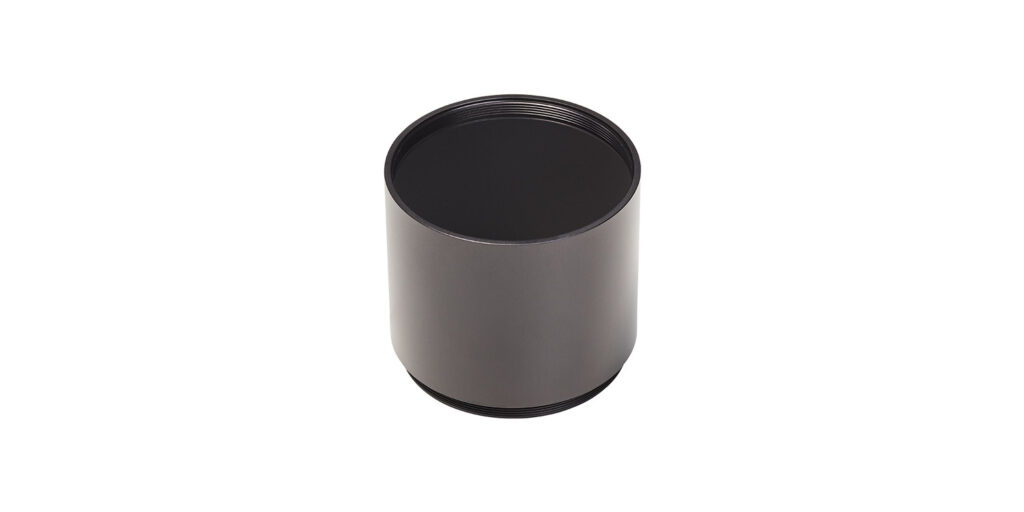
The main function of this useful accessory is to reduce glare and reflections caused by external light, particularly when the sun is low or the light is bright. By limiting the amount of stray light entering the lens, it improves image contrast and sharpness, allowing the shooter to better distinguish the target and its surroundings. It also protects against rain.
The sunshade thus contributes to more comfortable and accurate aiming, while helping to maintain consistent image quality regardless of lighting or atmospheric conditions.
Among the criteria for choosing a sporting rifle scope, the focal plane is a subject of prime importance because it directly influences how a shooter measures, corrects, and engages a target. Understanding the differences between these two configurations allows adapting the equipment to the shooting practice.
The focal plane refers to the position of the lens engraved with the reticle relative to the zoom mechanism of a rifle scope, as shown in the following illustration.

In the case of First Focal Plane (FFP) scopes, the reticle is placed in front of the zoom mechanism. This means that when the magnification is increased or decreased, the reticle adjusts proportionally to the image. The consequence is that the aiming marks and reticle graduations always retain the same value, regardless of the magnification selected.
In the case of Second Focal Plane (SFP) scopes, the reticle is positioned behind the zoom mechanism. Thus, when the magnification is increased or decreased, the image increases or decreases in size, but the reticle remains of the same apparent size.
On a FFP scope, the reticle enlarges and shrinks along with the image when the zoom ring is turned.
On a SFP scope, the reticle always remains the same visual size, while the image enlarges or shrinks when the zoom ring is turned.
The choice between First and Second Focal Plane is not a question of competence, but of coherence between optics and practice.
Before purchasing, it is essential to analyze your usual shooting distances, your correction methods, and your shooting environment.
For LRS and ELR, as well as PRS and its derivatives (Hunter, etc.), the First Focal Plane is highly recommended.
Indeed, if shooting requires frequent adjustments (or quick adjustments in competition situations), a FFP scope is the best choice. It allows you to rely on precise aiming points, even when changing the zoom level.
For Benchrest, and possibly F-Class, SFP scopes with their constant reticle size offer advantages.
When choosing a rifle scope, an essential aspect to consider is the choice of angle measurement unit, which corresponds to the unit in which elevation and windage corrections will be expressed and applied.
In the field of sport shooting, as well as operational shooting, two systems are used. They are based on the metric and imperial systems. Understanding them is fundamental to fully take advantage of a precision scope.
The milliradian (MRAD), often referred to as MIL, is an angular measurement unit based on the metric system.
The principle is as follows:
From a practical standpoint:
An example of how this system is used is as follows:
The advantages of the MRAD system are as follows:
The MOA (or “Minute of Angle”) is an angular unit derived from the imperial system.
The principle is as follows:
From a practical standpoint:
Using the example above to illustrate how this system works:
The advantage of the MOA system is as follows:
The disadvantages of the MOA system are as follows:
From an equivalence perspective, the above example illustrates the following conversion principle:
1 MRAD or MIL ≈ 3.438 MOA and 1 MOA ≈ 0.291 MRAD or MIL.
When choosing a scope, it is essential to ensure consistency between the reticle and the elevation and windage turrets: regardless of the system chosen, the reticle and turrets must be in the same unit, either MRAD or MIL + MRAD or MIL, or MOA + MOA. Mixing the two units would unnecessarily complicate corrections and significantly increase the risk of error.
MRAD or MIL on the one hand, and MOA on the other, are two effective systems for precision shooting.
It is therefore legitimate to question the importance of a more precise correction system on MOA scopes than on MRAD or MIL scopes. Indeed, for standard MRAD or MIL turrets, 1 click corresponds to 1 cm at 100 m, and for standard MOA turrets, 1 click corresponds to 0.73 cm at 100 m.
Some scope manufacturers, such as Schmidt & Bender, have taken this into account by offering turrets graduated in 0.05 MRAD or MIL on their LRS and ELR scopes, as well as turrets in 1/8 MOA on their Benchrest and long-range F-Class scopes. This additional level of mechanical precision commands higher prices and requires an adjustment in the number of clicks (which doubles compared to the number of standard clicks indicated by some ballistic calculators) and is generally only justified in the specific case of Benchrest or long-range F-Class competitions.
More generally, the assumption that the MOA system is more accurate than the MRAD system should be treated with extreme caution, as shooting accuracy depends primarily on the quality of the scope and the shooter, or even the entire shooting system comprising the weapon, ammunition, and shooter, rather than the angle measurement system.
Given its experience in this field, PGM Précision recommends choosing the MRAD or MIL system if the shooter wishes to practice LRS, ELR, or PRS, as it allows for quick and intuitive corrections. This also explains why this system tends to be the simplest, fastest, and most consistent solution for long-range shooting. Its metric logic, combined with modern reticles and current turrets, makes it the preferred choice of long-range shooting shooters and competitors.
However, for shooters who are already familiar with the MOA system, who already have MOA equipment, or who practice Benchrest or long-range F-Class shooting, a number of Schmidt & Bender scopes offered by PGM Précision are available with MOA turrets.
These disciplines impose specific constraints on rifles copes in order to accurately engage targets at 600 m, 800 m, 1,500 m, and even beyond, such as:
In addition, this rifle scope must meet a number of constraints related to the situation in which it is used, such as:
A precision, LRS, and ELR rifle scope must therefore be robust, accurate, reliable, and easy to read in all shooting conditions.
For LRS and ELR, these characteristics are as follows:
For novice shooters, magnification is usually the focus of attention. However, this factor alone does not improve shooting accuracy, which depends on three factors: the weapon, the ammunition, and the shooter.
A novice shooter is often tempted to set their scope to the highest magnification. While this allows them to see their target as clearly as possible, it also maximizes any shaking, produces image blurring, amplifies the mirage effect, and increases the discomfort caused by any disruptive elements (heat waves from the barrel, sound suppressor, smoke, etc.).
The quality of the lenses is paramount in this case, but it does not prevent the formation of these effects, which are detrimental to shooting, nor the fact that, with first focal plane scopes, the center of the target may be hidden by the reticle.
Finally, the higher the performance required of the optics and the higher the quality of the lenses needed to provide extreme magnification, the more expensive the rifle scope will be.
For LRS and ELR shots, the recommended magnification range is:
Beyond that, a larger magnification range may be useful, but in this case, more extensive consideration must be given to factors such as mounting height and the need to add a prism.
The current standard is to favor 56 mm lenses to ensure a good level of brightness and field of view.
It is also important to ensure that the manufacturer specifies that the lens glass is of high quality, high contrast, and has undergone multi-layer treatment.
For the shooting disciplines covered in this article, a First Focal Plane (FFP) reticle is highly recommended. For F-Class or Benchrest shooting, a Second Focal Plane (SFP) reticle may sometimes be more suitable.
In a European setting, an MRAD or MIL reticle should be preferred, whereas an MOA system may be preferred in an Anglo-Saxon environment. This advice should be qualified, however, as many American shooters have been switching to the metric system (MRAD or MIL) for the past fifteen years or so, as evidenced by the supply of Schmidt & Bender 3-12×50 PM II LP P3L scopes to the United States Marine Corps (USMC).
Depending on the shooter’s preferences, the choice of reticle is between:
If the shooter has the services of a spotter, it is important to have angle measurement systems and reticles that are consistent between the shooter’s rifle scope and the spotter’s observation scope.
Naturally, the scope must feature diopter adjustment to ensure perfectly clear vision of the reticle (generally at a distance of 3 to 6 inches (7 to 15 cm), which is the recommended optimal distance between the eyepiece lens and the eye to obtain a consistent, stable image and protect against recoil). This distance is 3.5 inches (9 cm) for Schmidt & Bender scopes.
Finally, the ability to illuminate the reticle at variable levels can be a source of considerable comfort when shooting at targets with dark centers or in low light conditions.
They must be of excellent quality because the repeatability of the shots depends on them.
In LRS and ELR, the turrets must be visible with easily legible engravings. They must also be adjustable by hand with regular, clear clicks, allow disengaging for zeroing, and ideally equipped with a zero-stop device in case the shooter has not memorized the number of turns of the elevation turret.
An indicator showing the number of elevation turns made is very useful during long shooting sessions or competitions, as is the ability to lock the turrets.
Compared to investing in extreme magnification, investing in a scope with excellent mechanical quality is much more relevant because it will ensure perfect ergonomics and repeatability of shots.
The quality of the turrets often allows one to judge the overall mechanical quality of the precision rifle scope, which, for long range shooting and ELR, must be of the highest order.
This adjustment is essential given the variety of distances at which targets can be engaged in precision shooting, long range shooting, and extreme long range. It must cover distances from 20 to 30 yards (20 to 25 meters) to infinity (ideally engraved on the parallax turret) and its control must be smooth and progressive.
Regardless of the intrinsic quality of the scope, its performance in precision shooting, long range shooting, and extreme long-range shooting is largely dependent on the mounting system that attaches it to the rifle. Too often underestimated, mount is nevertheless a key element in the precision chain. An unsuitable or poor-quality system can negate the advantages of even the best optics.
The mounting system is the direct interface between the rifle and the scope. It must ensure a perfectly stable attachment, capable of withstanding the mechanical stresses generated by recoil, vibrations and environmental variations.
A reliable mount prevents even the slightest movement of the optics. In precision shooting, a few fractions of a millimeter are enough to cause significant deviations on the target, especially at long distances.
Accuracy depends not only on accurate shooting, but also on repeatability. A good mounting system ensures that the scope retains its zero over time, even after numerous shots or repeated handling.
In certain contexts, the ability to disassemble and reassemble a scope without losing its settings is also essential. Mounts designed with strict tolerances guarantee this consistency, which is paramount for demanding shooters.
In addition, the mounting system will directly determine the distance at which the scope can be used by the shooter. This is because every scope has a maximum level of elevation and windage adjustment linked to the free space in which the internal tube can be moved within the scope body. To exceed this maximum elevation, with the same ammunition, the mounting system can be invaluable.
Two essential components make up the scope mounting system: the support rail and the scope mount.
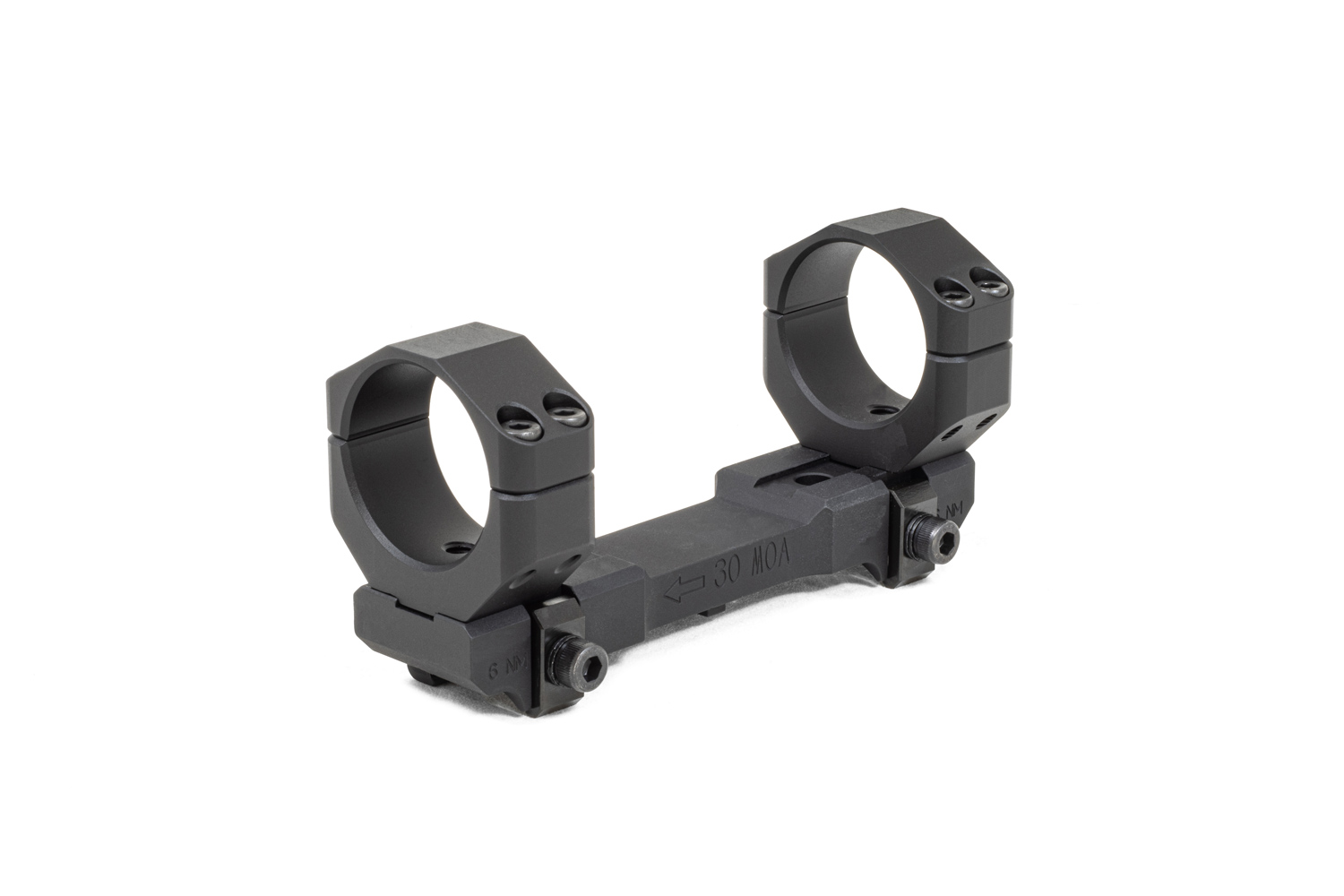
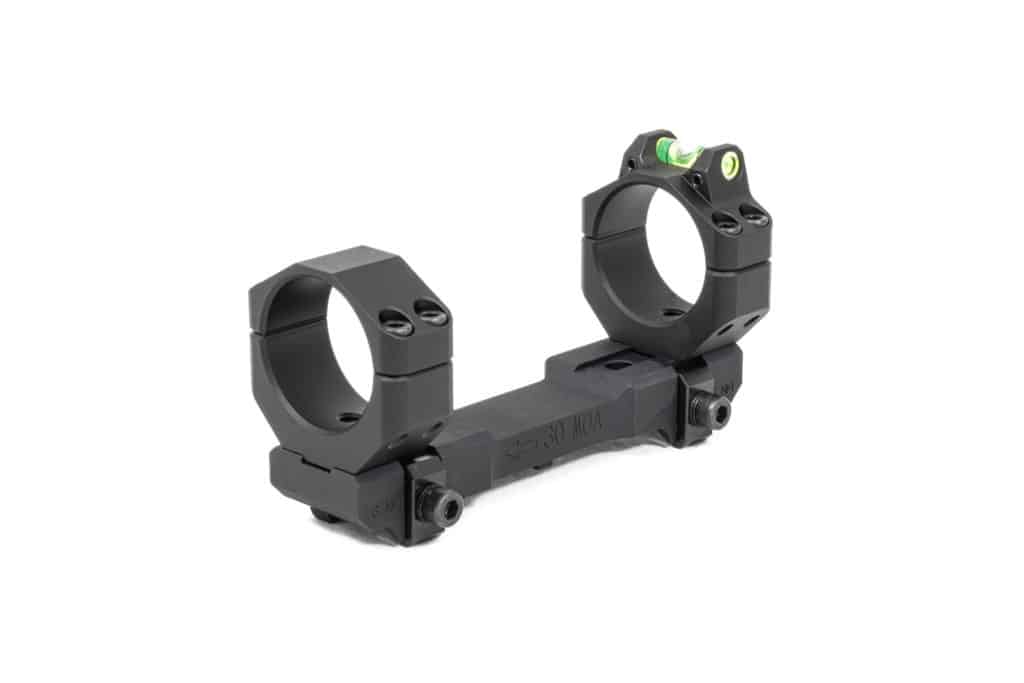
The Picatinny rail, which is the current standard, is mounted directly onto the rifle receiver with a high degree of precision to ensure perfect alignment between the rifle’s axis and that of the scope.
In the PGM Precision rifle range, these rails can be 8 inches (20 cm) long (making them the most effective and economical option for sport shooters) or 20 inches (50 cm) long (more expensive, heavier, and mainly intended for operational shooters who need to be able to attach night vision optics in front of the scope, or ELR sport shooters who need to mount certain prisms in front of their scope to see their targets at extreme distances). These rails can have a slope of 20 MOA to 54 MOA (on short 8 inches (20 cm) rails: slope of 20, 30, 50, or 54 MOA – on long 20 inches (50 cm) rails: slope of 20 MOA), which gives the rifle scope an initial angle that allows for aiming at a greater distance.
In order to achieve maximum strength and mounting quality, PGM Précision offers one-piece scope mounts with an anti-recoil lug that fits perfectly onto the rifle’s Picatinny rail. They are manufactured from 7075 aeronautical aluminum alloy, making them extremely strong yet lightweight.
The length of PGM Précision mounts complies with the STANAG standard, as does the attachment of the rings, which is particularly useful for customers who wish to attach their rings to a commercially available STANAG rail, for example.
It is easy to use with its Picatinny rail mounting system secured by two screws, and it has four ring slots for advanced modularity (for example, in cases where there is not enough space around the turrets for a “standard” ring spacing). Another important feature is that it does not compress or mark the body of the scope and does not require breaking in.
The mounts also increase the aiming range thanks to 0, 30, and 50 MOA slopes, while ensuring the weapon remains horizontal thanks to a perfectly integrated and visible bubble level (optional).
These mounts are perfectly suited to Schmidt & Bender rifle scopes with a body diameter of 34 mm, but also to almost all rifle scopes on the market with bodies measuring 30, 34, 35, or 36 mm.
The practice of precision shooting, LRS, or ELR requires the use of a sloped mount to shoot beyond the maximum distance allowed by the maximum useful elevation of the scope alone.
Depending on the characteristics of the rifle and ammunition, it is possible to calculate the maximum shooting range in cases where the mount does not have elevation, then estimate the elevation required to reach a selected range, or even estimate the maximum range that can be achieved.
To illustrate this point, let’s take the example of a sport shooter equipped with a PGM Précision Ultima Ratio New Generation rifle chambered in .308 Winchester caliber and fitted with a custom 28 inch (71 cm) barrel. It is equipped with a Schmidt & Bender 5-25×56 PM II LP scope with DT/ST turrets that allow for a maximum elevation of 26 MRAD or MIL (260 clicks), initially mounted without any slope, neither on the Picatinny rail nor on the scope mount.
The sight height is 2.75 inch (70 mm), the scope is zeroed at 110 yards (100 m), and this zeroing uses approximately 130 MRAD or MIL (equivalent to 130 clicks).
RWS ammunition features 167-grain Lapua Scenar HPBT bullets (G7 ballistic coefficient: 0.216) with a muzzle velocity of 2.657 ft/s (810 m/s) under standard ICAO atmospheric conditions on a windless day.
Calculation of the maximum shooting distance without elevation of the scope mount
After zeroing, there are approximately 26 – 13 = 13 MRAD or MIL of useful elevation remaining. Using a ballistic calculator shows that these 130 clicks allow shots to be fired at a distance of up to 1.022 yards (935 m).
Important note: The calculations in this section do not take into account the margin that some rifle scopes manufacturers may add to the official elevation as a “zeroing margin.”
Estimation of the elevation of the mount required to reach a selected distance
If the shooter wants to be able to hit a target at 1,422 yards (1,300 m) (for example, which is close to the limit for caliber .308 Winchester), they will need to use a sloped Picatinny rail or a sloped scope mount to add slope to the maximum elevation of their scope, which is insufficient.
To calculate the minimum number of MOAs required to achieve this distance, he can use the following method:
. The ballistic calculator shows that a total elevation of 26.59 MRAD or MIL is required to hit a target at 1,422 yards (1,300 m).
. The MRAD or MIL deficit relative to the useful elevation of its scope is 26.59 – 13 = 13.59 MRAD or MIL.
. Using the conversion stipulating that 1 MRAD or MIL ≈ 3.438 MOA, we can calculate that 13.59 MRAD or MIL = 46.72 MOA, rounded to 47 MOA.
. The rail, scope mount, or combination of both must therefore have a slope of at least 47 MOA to reach a distance of 1,422 yards (1,300 m).
The shooter can therefore choose to equip their Ultima Ratio NG with a 0 MOA angled Picatinny rail and a 50 MOA angled scope mount, or a 20 MOA angled Picatinny rail and a 30 MOA angled scope mount, or any other combination that produces a total angle of at least 47 MOA.
Calculating the maximum shooting distance with a scope mount elevation
From a theoretical standpoint, it is possible to calculate the maximum distance that could be achieved by this shooter with his Schmidt & Bender 5-25×56 PM II LP scope with DT/ST turrets by adding a rail and a 50 MOA combined slope scope mount.
In this case, the 13 MRAD or MIL of useful elevation of the scope is added to the 50 MOA total of the mount, or 14.54 MRAD or MIL, to produce at a total elevation of 27.54 MRAD or MIL.
A ballistic calculator shows that this elevation corresponds to a shooting distance of 1,445 yards (1,321 m) under the specified conditions.
There is no doubt that the shooter will be able to use the 3.3 seconds of flight time of his bullet to appreciate the potential of his scope and mount!
PGM Précision has chosen Schmidt & Bender scopes to complement their rifles due to the reputation for quality, both mechanically and optically, as well as in terms of service, that this German company has demonstrated in the manufacturing of their precision shooting scopes.
This alignment between the qualities of the two brands’ products for over 20 years has made it possible to offer a consistent rifle-scope combination capable of satisfying the most demanding shooters in the most extreme conditions.
Schmidt & Bender also offers the world’s widest range of products, covering all shooting disciplines.
This manufacturer offers several ranges of rifle scopes for both operational/tactical and sporting use.
The following rifle scopes are primarily used for operational purposes:

Delivered in 2019 to the French Armed Forces for the new “FPSA” semi-automatic sniper rifle, the 1-8×24 PM II ShortDot Dual CC rifle scope has since been used by other NATO countries, US special forces, and counterterrorism units. Compact, it allows for fast and reliable target acquisition thanks to its large exit pupil and is a unique concept that combines two products: a red dot sight with 1x magnification and a tactical telescopic sight with up to 8x magnification. The patented CC mode guarantees parallax-free shooting at short range. Beyond this mode, this scope allows parallax-free shooting at 110 yard (100 m), or even 330 yards (300 m) on request. This level of sophistication comes at a cost that limits the appeal of this scope for sport shooters.

It is the most legendary rifle scope in the world and the only scope to have withstood two years of intensive quality and endurance testing by the United States Marine Corps (USMC). For more than 25 years, the 3-12×50 PM II has been a best-seller that has proven itself with police and military forces in many NATO countries. Its exceptional optical and mechanical quality is unmatched. However, for sport shooting, its magnification range is too limited for use in precision or long-range shooting.

This evolution of the 3-20×50 PM II, which is no longer available, offers the widest field of view and is also the shortest and lightest rifle scope in its class. Its length is almost identical to that of the legendary 3-12×50 PM II, making it the ideal upgrade for precision rifles and snipers, especially since it can be equipped with a turret with an elevation range of up to 35 MRAD or MIL.
The 3-20×50 PM II won the US Army’s CSASS program. Since then, it has been used by the US Air Force and the Canadian Armed Forces. Police and counterterrorism units also rely on the 3-20×50 PM II Ultra Short.

Thanks to its 9x zoom, it can be used at distances ranging from short to very long ranges.
Originally developed for the USSOCOM’s Extreme Long Range program, which it won in 2012, it has since become the optic of choice for snipers, particularly among many NATO partners, police forces, and counterterrorism units. Its versatility makes it ideal for multi-caliber platforms, but it is a very expensive option for sport shooters.

It is the shortest rifle scope in the world while still being fully functional.
It won the “G210” tender issued by the German special forces KSK and KSM and is also used by the Dutch special forces and other special forces, including those of NATO partner countries and counterterrorism units.
This scope can be equipped with a turret with an elevation range of up to 35 MRAD or MIL, but this is an expensive option for sport shooters.

It is one of Schmidt & Bender’s most popular rifle scopes and one of the most versatile.
In the operational field, it has been an integral part of the equipment used by police forces, military units, and special forces around the world for more than 15 years. In 2011, for example, it won the prestigious USSOCOM tender for the “Precision Rifle.” Today, it continues to dominate its competitors in tenders.
Optically, it has been the benchmark for 5-25×56 rifle scopes for nearly two decades. The parallax can be precisely adjusted from 11 yards (10 meters). The high-performance design of the 5-25×56 PM II is constantly being improved. The new magnification adjustment system is made of high-quality aluminum and is compatible with the magnification lever.
This scope offers one of the best performance-to-price ratios in the range.

It is a recent evolution of the legendary 5-25×56 PM II scope and excels at medium to extremely long ranges.
Since its launch, it has been popular with the military and has been used in .50 caliber anti-material rifles since 2023. More recently, it has also won over special forces units.
No other scope in its class offers such a wide field of view. Even at 6x magnification, its field of view surpasses that of most 5-25x scopes on the market. In addition to this field of view, its remarkable resolution for target recognition and observation beyond 4,374 yards (4,000 m) is also impressive. Schmidt & Bender’s patented coating technology guarantees light transmission of over 90%. Slightly shorter than the 5-25×56 PM II, it can be equipped with a turret with an elevation of up to 35 MRAD or MIL.
This scope offers one of the best performance-to-price ratios in the range.

This model combines the functions of a precision rifle scope and of an observation scope.
It is used by certain special police units responsible for airport security, and is also in service with the armed forces of the Netherlands and other countries.
Its powerful 9x zoom and magnification range from 5x to 45x enable precise observation, target identification, and high-precision shooting. In addition to its excellent resolution, it offers a wide field of view, ensuring good visibility despite the high magnification.
Its high magnification makes this precision rifle scope suitable for medium to extreme range shooting and observation missions. Its high price reflects the combination of its two functions.
The rifle scopes mainly used for sport shooting, for LRS and ELR, are as follows:
It is one of Schmidt & Bender’s most popular riflescopes and one of the most versatile. The 5-25×56 PM II is THE legendary model offered by PGM Précision to sport shooters for over 20 years.
In this field, it is a benchmark product used by many precision shooters, LRS and ELR practitioners who appreciate its optical quality and the choice of three different turrets and four reticles adapted to specific uses.
The parallax can be precisely adjusted from 11 yards (10 meters), and the high-performance design of the 5-25×56 PM II is constantly being improved. The new magnification adjustment system is made of high-quality aluminum and is compatible with the magnification lever.
This scope accepts a wide range of turrets, including the DT35, which can reach an elevation of up to 35 MRAD or MIL.
This scope offers one of the best performance-to-price ratios in the Schmidt & Bender range.
Like the 5-25×56 PM II, this scope is also a benchmark in the field of LRS and ELR, equipping many competitors who shoot up to 2,200 yards (2,000 meters) or more.
No other scope in its class offers such a wide field of view. Even at 6x magnification, its field of view surpasses that of most 5-25 scopes on the market. In addition to this field of view, its remarkable resolution for target recognition beyond 4,400 yards (4,000 meters) is also impressive. Schmidt & Bender’s patented multi-layer coating technology guarantees light transmission of over 90%. With its compact design and low weight, the 6-36×56 PM II High Performance is the lightest riflescope in its class.
It has a wide internal adjustment range of over 40 MRAD or MIL. Equipped with the new LPI (Integrated Illuminated Parallax) system, it offers more mounting options and is ideal for left-handed shooters. This scope accepts a wide range of turrets, including the DT35 with an elevation range of up to 35 MRAD or MIL.
This scope offers one of the best performance-to-price ratios in the Schmidt & Bender range.
This model combines the functions of a precision rifle scope and an observation scope.
It is used by certain special police units responsible for airport security, and is also in service with the armed forces of the Netherlands and other countries.
Its powerful 9x zoom and magnification range from 5x to 45x enable precise observation, target identification, and high-precision shooting. In addition to its excellent resolution, it offers a wide field of view, ensuring good visibility despite the high magnification.
Its high magnification makes this precision rifle scope suitable for medium to extreme range shooting and observation missions. Its high price reflects the combination of its two functions.
This range is complemented by a model designed specifically for sports:

This rifle scope is dedicated to Benchrest competition shooters as well as long-distance F-Class shooters.
Its two versions, in First and Second Focal Plane (respectively in MRAD or MIL with illuminated reticle or in MOA without illuminated reticle), demonstrate its suitability as a precision competition scope. It offers exceptional performance, such as a wide field of view combined with a generous exit pupil/eye relief, ensuring comfortable target acquisition and setting a new benchmark.
The 10-60×56 CM II High Performance accepts DTII+ and MTII turrets optimized for competition. They feature 1/20 MRAD or MIL or 1/8 MOA (Double Turn II+) clicks for finer adjustments, double height for easier-to-read engravings, more tactile clicks, and sub-zero clicks.
As one of the most specialized scopes in the range, it requires a high level of skill on the part of the shooter to use it to its full potential.
With over 30 years of experience in meeting the needs of the most demanding operational units, benefiting from their feedback and that of high-level competitive shooters, PGM Précision offers the following summary regarding the choice of a scope and its mount for precision shooting, LRS and ELR.
The high standards of these disciplines mean that every detail counts. A suitable rifle scope must offer high-quality optics, flawless mechanics, and ergonomics designed for quick adjustments.
The choice of a precision scope must also be consistent with the other components of the weapon-ammunition-shooter system. The quality of the scope must be in line with the quality of the rifle and ammunition for the whole system to perform optimally. A significant investment in a high-quality scope mounted on a rifle whose trigger, chamber, or barrel only allows for approximate shots will only marginally increase the number of hits in the center of the target, and vice versa.
Finally, despite all the care and attention that a manufacturer may devote to the production of precision scopes, a problem, a need for adjustment, or a need for maintenance may require a return to Customer Service. In this case, choosing a European manufacturer and the ease of returning the product to the after-sales service makes perfect sense in terms of time saved, concerns about shipping outside the EEC (pro forma invoice, customs), etc.
In conclusion, when chosen well, a precision rifle scope becomes a true ballistic tool that contributes to the shooter’s accuracy and consistency.
| Characteristic | Precision Shooter (F-Class, Benchrest, etc.) | Intermediate LRS Shooter | Advanced or Competition LRS or ELR shooter |
| Magnification range | x5 – x25 or x6 – x36 x5 – x45 or x10 – x60 (Long-range F-Class, Benchrest) | x5 – x25 | x6 – x36 ou x5 – x45 (ELR) |
| Objective lens diameter | 56 mm | 56 mm | 56 mm |
| Light transmission | Very good | Very good | Exceptional (> 90%) |
| Reticle type | First Focal Plane with graduations (P4FL or P5FL) or Second Focal Plane with TremorTM or GR²ID (long-range F-Class, Benchrest) | First Focal Plane with graduations (P4FL or P5FL) | First Focal Plane with graduations (P4FL or P5FL) |
| Reticle graduations | Fine graduations + advanced markings | Clear graduations | Fine graduations + advanced markings |
| Measurement system | MRAD or MIL | MRAD or MIL | MRAD or MIL |
| Turrets | 0.1 MRAD or MIL click, or even 0.05 MRAD or MIL for some long-range F-Class or Benchrest shooters Zero stop + turn indicator | 0.1 MRAD or MIL click Zero stop + turn indicator | 0.1 MRAD or MIL click, or even 0.05 MRAD or MIL for some ELR shooters Zero stop + turn indicator |
| Total elevation capacity | ~ 25–30 MRAD or MIL | ~ 25–30 MRAD or MIL | > 30 MRAD or MIL |
| Rotation | CW or CCW, depending on habit or preference | CW or CCW, depending on habit or preference | CW or CCW, depending on habit or preference |
| Parallax adjustment | Yes, precise without any sticking points | Yes, precise without any sticking points | Yes, precise without any sticking points |
| Robustness | Very robust | Very robust | Extremely robust |
| Weight | Medium | Medium | Medium to high |
| Indicative price | Medium to high | Medium to high | High |
| Accessory | Sunshade | Sunshade (optional) | Sunshade |
| Examples from the Schmidt & Bender range | S&B 5-25×56 PM II, S&B 6-36×56 PM II High Performance or S&B 5-45×56 PM II, S&B 10-60×56 CM II (long range F-Class or Benchrest) | S&B 5-25×56 PM II | S&B 6-36×56 PM II High Performance, S&B 5-45×56 PM II (ELR) |
Please note: the two models of precision shooting scopes that are the Schmidt & Bender 5-25×56 PM II P4FL and P5FL and the Schmidt & Bender 6-36×56 PM II High Performance P5FL account for the vast majority of sales that PGM Précision has made to high-level LRS and ELR shooters.
| Characteristic | Precision Shooter (F-Class, Benchrest, etc.) | Intermediate LRS Shooter | Advanced or Competition LRS or ELR shooter |
| Mounting rail | Picatinny, short (8 inches / 20 cm) | Picatinny, short (8 inches / 20 cm) | Picatinny, short (20 cm) Picatinny, long (50 cm) for ELR if prism |
| Rail slope | 20 or 30 MOA | 20 or 30 MOA | From 20 to 54 MOA |
| Scope mount | Monoblock | Monoblock | Monoblock |
| Scope mount slope | 0 or 30 MOA | 0 or 30 MOA | 30 MOA |
| Accessory | Bubble level | Bubble level (optional) | Bubble level |
| Robustness | Very robust | Very robust | Extremely robust |
| Indicative price | Medium to high | Medium to high | High |
Need advice?
×
