The purpose of this article is to define and explore in depth the stabilization systems that a competitive shooter can use in precision shooting, long-range shooting (LRS), and, by extension, Extreme Long Range (ELR), as these disciplines place high demands on consistency, shot reproducibility, and technical mastery.
Among these factors, stability is fundamental to accuracy. Indeed, it directly affects the quality of the aim, recoil control, the reduction of unwanted movement, and the control of muzzle drift—a common source of lateral errors at long range.
In this context, the bipod (front support), the monopod, and the bag rider (rear support) emerge as key structural components of the firearm-ammunition-shooter system. Their role goes far beyond simple comfort: they directly contribute to the practical realization of theoretical ballistic performance and the final outcome of the shot.
This article begins by summarizing the factors affecting the stability of the firearm, and then reviews, in turn, the role, design, technical characteristics, and selection criteria for bipods, monopods, and bag riders.
It also covers a number of additional accessories, such as shooting boards and bubble levels, and explains their uses.
Finally, it discusses the criteria for selecting bipods, monopods, and bag riders, while explaining PGM Précision’s product lineup for these accessories.
This article is intended as a guide for a wide range of applications, including LRS on gongs for recreational or competitive shooting, Extreme Long Range (ELR) shooting, F-Class, Precision Rifle Shooting (PRS), Benchrest, and more. It summarizes the recommendations and advice that PGM Précision can offer based on its experience and history, but it is not intended to represent the sum of all available knowledge on rifle stabilization, nor is it meant to be prescriptive: each shooter is free to make their own choice based on personal criteria, aided by the information below.
Precision shooting and LRS are based on a fundamental principle: the ability to reproduce identical initial conditions with every shot.
While external ballistics, including the projectile’s trajectory, wind effects, and air density, etc., are often highlighted, internal and intermediate ballistics, that is, the weapon’s behavior at the moment of firing, constitutes an essential aspect depending heavily on the stability of the weapon system.
In fact, any angular variation of the barrel axis at the moment of firing results in increased dispersion. This dispersion increases with distance, making mechanical stabilization of the firearm essential. From this perspective, the choice of a bipod, a monopod, or a bag rider and their associated accessories is not simply a matter of comfort, it constitutes a critical technical decision that directly influences accuracy, repeatability, and recoil management.
The factors that influence shooting accuracy, before external ballistic parameters come into play, can be classified as follows:
It is the shooter who is responsible for controlling their breathing, managing their relaxation, and maintaining proper positioning; in precision shooting, the stability of the firearm does not depend solely on mechanical devices, but stems largely from the shooter’s fundamental skills:
All of these factors contribute to minimizing unwanted movement, ensuring better recoil control, and, ultimately, guaranteeing more consistent hits on the target.
They play a crucial role in the stability of the firearm and, consequently, in the quality of the shot:
Therefore, reading the terrain and adapting to its characteristics are essential skills for ensuring optimal stability and consistency in shooting.
These points relate to topics such as barrel quality, the precision of optical adjustments, and so on. The first two topics, along with the choice of caliber, have been covered in previous articles by PGM Insight, available in the PGM Precision / Insight section of the website
Future articles will explore other technical aspects in greater depth.
In the context of precision sport shooting, the stability of the shooting platform is a critical factor that results from the seamless interaction between the shooter’s position, the quality of the supports, and the overall suitability of the system for its intended use. In terms of equipment, the quality of the supports (bipod, monopod, or bag rider—including their rigidity, adjustability, and interface with the ground) directly influences the reduction of unwanted movement and the management of recoil.
Finally, the system’s consistency—that is, the harmony between the firearm, its accessories, and the shooting conditions (prone, with support, on uneven ground)—ensures a consistent mechanical response at the moment of firing.
A well-designed and properly adjusted platform thus enables linear recoil, consistent alignment with the target, and improved shot consistency—all essential for long-range accuracy. This is the focus of this article.
In precision sport shooting, the bipod is a key component in ensuring the stability of the firearm, particularly in prone shooting and LRS disciplines.
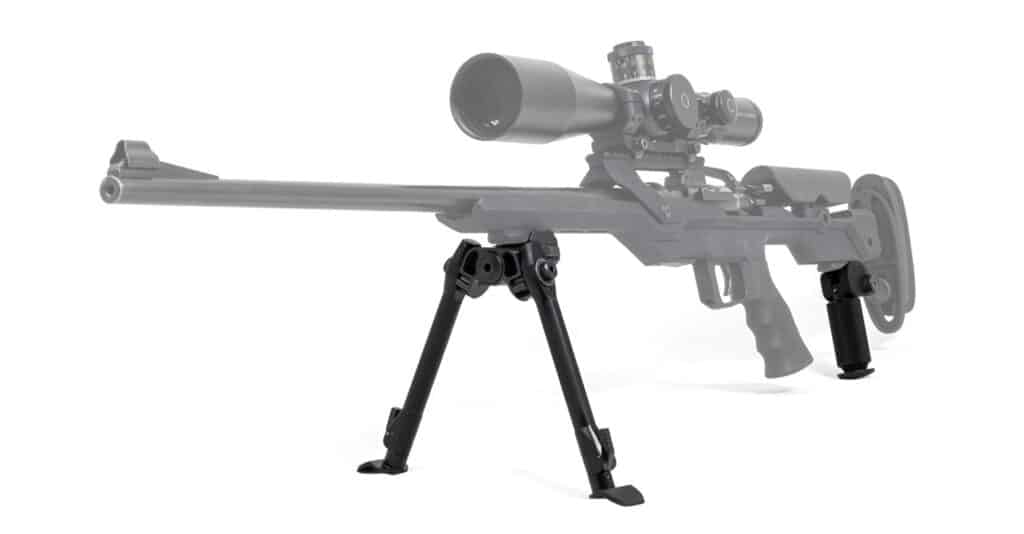
A bipod is a mechanical device consisting of two articulated legs, attached to the front of the firearm, typically beneath the barrel.
It is designed to create a stable point of support between the firearm and the ground or any other shooting surface.
It is mounted using various standardized interfaces, including Picatinny rails, Arca rails, or proprietary systems, ensuring a rigid and reliable attachment.
The choice of mounting type directly influences modularity, speed of installation, and compatibility with other accessories, making it an important factor in the overall configuration of the firearm.

The bipod serves multiple purposes that are essential to the shooter’s performance.
They are as follows:
There are several types of bipods, each designed to meet specific needs:
The balance between lightness and sturdiness is a key consideration: a lightweight bipod enhances mobility but may lack rigidity, whereas a heavier model offers greater inertia and increased resistance to mechanical stress, at the cost of added weight.
Among the key technical features of bipods, the following points are worth noting:
Stability factors related to the use of a bipod are also essential to consider:
In terms of advantages, the bipod proves particularly effective in a prone position, where it provides a stable and consistent platform, facilitating consistent shots.
However, it also has certain limitations, particularly on uneven terrain or unstable surfaces, where grip may be compromised and require constant adjustments. Therefore, the choice and use of a bipod must always be adapted to the actual shooting conditions in order to fully exploit its potential.
The criteria for choosing a bipod depend on the type of shooting practice and its intended use:
Regarding the bipod’s height and adjustments, it is important to know the height of the rifle, as this affects the type of adjustment and the shooter’s optimal position:
The mounting system available on the rifle must be taken into account to ensure the bipod is compatible:
The movement capabilities the shooter needs must be identified and controllable to ensure the required stability:
Originally integrated into PGM Precision rifles, the TLS bipods offered by the brand have proven themselves around the world, whether in military, police, or sporting applications.
Made from 7075 aircraft-grade aluminum alloy and steel, PGM Precision bipods are extremely sturdy and lightweight. Their legs fold individually backward or forward at various angles and are height-adjustable.
The force of the recoil and tracking brakes can be adjusted using a simple hex wrench, and mounting on any Picatinny or ARCA rail (depending on the model) is done simply by tightening the bipod lever.
PGM Precision bipods also feature a set screw that allows them to adapt perfectly to Picatinny or ARCA rails that may have been manufactured with less strict tolerances. This detail is particularly important in practice, especially when a shooter uses the same bipod on multiple rifles.
An important point to note is that all parts of PGM Précision bipods are interchangeable thanks to extremely precise machining methods.
PGM Précision’s range of four bipods is organized as follows:

This is a universal bipod for Picatinny rails used by numerous operational units and found on over 2,600 SCAR-H PR rifles in the French Army. A true benchmark in the world of sporting and operational long-range shooting, this PGM bipod offers exceptional stability and maximum shooting comfort. This universal version can be mounted on any rifle equipped with a Picatinny rail.
The main features of the PGM Picatinny bipod are as follows:
Used by many sport shooters, this bipod is highly regarded for its simplicity and effectiveness. It features a compact, lightweight design that fits on all firearms while offering exceptional stability and performance.
This bipod is available as an accessory for all third-party rifles equipped with a Picatinny rail for mounting.

Having become a de facto standard in the long-range shooting community over the past few years, the ARCA interface is now the go-to solution for mounting bipods on LRS rifles. PGM Précision offers its renowned bipod in this version, which is compatible with any firearm equipped with an ARCA rail, including its own models.
Originating in the photography industry, the ARCA interface has found its way into long-range and precision shooting for mounting rifles on tripods. This interface allows for the stable and secure attachment of accessories while offering greater modularity and speed when changing configurations. The use of the PGM ARCA bipod is therefore particularly useful, especially for sliding the bipod along the rail when changing its position.
The main features of the Arca bipod are as follows:
Used by many sport shooters, this bipod is highly regarded for its simplicity and effectiveness. It features a compact and lightweight design that fits all firearms while offering exceptional stability and performance.
This bipod comes standard with the PGM Ultima Ratio and is available as an accessory for all third-party rifles equipped with a chassis featuring an Arca rail for mounting.

Designed for very long-range shooting and ELR, this bipod—which features a Picatinny or proprietary PGM interface—incorporates the key features of the standard PGM bipod and offers, in addition, a wider base to lower the weapon’s center of gravity and improve accuracy during ELR shooting.
The main features of the Picatinny Arca bipod are as follows:
Modern precision shooting relies heavily on the use of mechanical supports to stabilize the firearm. In many disciplines, particularly in certain competitions, the firearm is not allowed to come into direct contact with the ground. This underscores the importance of the bipod and the rear support in creating a stable shooting platform.
In precision shooting, the monopod serves as a second key element in stabilizing the rear of the firearm, complementing the role of the bipod to form a coherent and balanced platform.
By definition, the monopod is a single-legged support, typically mounted under the stock of the firearm, designed to provide an adjustable point of contact between the rear of the firearm and the ground or a shooting surface. Unlike a passive support such as a bag, the monopod is designed for active mechanical adjustment, allowing the shooter to precisely adjust the height and sometimes the angle of the stock. This adjustability makes it a particularly valuable tool in LRS disciplines where angular accuracy is critical.

The essential functions of the monopod or stock rest revolve around three main principles:
There are several types of monopods, each with features suited to specific uses:

This accessory is based on the legendary stock rests that have been a standard feature of PGM Précision rifles for nearly 30 years, and it can be mounted on any firearm equipped with a Picatinny rail under the stock.
It allows for ultra-precise sight adjustments. In fact, the PGM stock rests can be adjusted for height with micrometric precision simply by turning the handle. This extreme precision in adjustment, combined with the stability provided by the ground contact at the rear of the weapon, allows for extremely fine sight adjustments.
Like all accessories of this type from the brand, the PGM stock rest is made of 7075 aircraft-grade aluminum alloy and offers an excellent weight-to-strength ratio. It weighs only 270 grams and fits perfectly on almost any firearm thanks to its compact design. Rated up to .50 BMG caliber, it offers exceptional strength.
Already trusted by thousands of demanding shooters, the main advantages of the PGM stock rest are as follows:
The bag rider is a component of the firearm’s rear stabilization system that is useful for certain specialized applications where a monopod is not suitable. For the vast majority of uses, its main drawbacks are its weight and the fact that it requires the shooter to have a rear support bag to use it. As such, it demands more organization and planning for shooting sessions and is a less “practical and versatile” solution than the stock rest.
The stock shoe is the lower end of the stock, in direct contact with an intermediate support such as a rear bag. It can be fixed or adjustable, and its design directly influences the quality of the interface between the firearm, the shooter, and the support. The bag rider, like the monopod, plays a decisive role in force transmission, recoil management, and the overall stability of the system. It thus constitutes a strategic point of support, both mechanical and ergonomic, that contributes to the coherence of the shooting platform.

The bag rider serves several essential functions:
There are several types of bag riders, each designed to meet specific needs:
When properly selected and adjusted, it significantly contributes to shooting consistency, recoil control, and optimal positioning—essential elements for performance in precision shooting sports. This explains their presence on the firearms of many LRS and ELR competitors.
In summary, choosing a bag rider involves striking a balance between ergonomics, recoil absorption, compatibility with mounts, build quality, and adjustability—all of which must align with the shooter’s style, the discipline being practiced, and the conditions of use.

Designed for Benchrest, LRS, and ELR shooters in mind, this bag rider allows for micrometric height adjustment and maximum stability when used on a rear support bag.
Developed in collaboration with LRS specialists, it is a benchmark accessory available for all rifles equipped with a Picatinny rail under the stock.
Its 100% French manufacturing, using high-quality materials and state-of-the-art methods, guarantees many years of heavy-duty use.
The seamless integration of the bipod, rear monopod, or bag rider with the shooter’s body represents a crucial step toward achieving a stable and consistent platform.
This three-point system – bipod at the front, rear support, and body anchorage – creates a triangle of stability essential for limiting unwanted oscillations. The bipod ensures a firm footing along the weapon’s longitudinal axis, while the rear support refines height and windage adjustments, and the shooter’s body acts as a dynamic shock absorber, absorbing micro-variations and contributing to consistent positioning.
Complementary and optional accessories are added to this “architecture,” ensuring perfect alignment of the firearm to prevent any lateral tilt that could alter the projectile’s trajectory at long range.
The shooting board is an important accessory in precision shooting, designed to provide a stable, even surface when the natural terrain does not allow for it. Typically made by the shooter from wood, rigid polymer, or aluminum, it takes the form of a flat plate wide enough to accommodate the bipod and sometimes part of the shooter’s body.
Its primary role is to compensate for ground irregularities – grass, gravel, mud, or sand – that can compromise the stability of the firearm and affect the consistency of shots. By creating a solid interface between the bipod and the ground, the shooting board allows for better weight distribution, preventing unexpected sinking or slipping when the shot is fired.
Among its advantages are a significant reduction in micro-movements, improved position repeatability, and greater consistency in the weapon’s recoil behavior. It also facilitates the shooter’s quick setup on various types of terrain, while limiting the influence of external conditions. Some shooters add spirit levels and wide, height-adjustable pads to ensure a perfectly horizontal surface for their bipod.
In short, the shooting board is a simple yet effective tool for optimizing stability and, consequently, overall shooting accuracy, at the cost of one more item to carry to the shooting range.

In long-range shooting, the use of a spirit level is crucial for ensuring the rifle is perfectly level, which is essential for ballistic accuracy. In fact, even the slightest lateral tilt can cause a significant deviation in the point of impact, particularly as the distance increases.
The spirit level, typically mounted on a Picatinny rail or integrated into the scope mount – as is the case with PGM Précision models – allows the shooter to instantly verify that the firearm is perfectly aligned with the vertical axis.
Learn more about PGM Précision scope mounts
This simple visual check prevents systematic errors that are otherwise difficult to correct, especially when visual landmarks on the ground are misleading. One of the main advantages of this accessory is improved consistency: each shot is fired under the same alignment conditions, which reduces the spread of impacts.
It also helps enhance the shooter’s technical precision by encouraging them to incorporate an additional check into their shooting sequence. Finally, in demanding situations such as competitions or shooting under variable conditions, the spirit level becomes an indispensable tool for maintaining consistency and optimizing performance at long range.
The example below illustrates this point. A 2° horizontal error – in other words, a tilt of the firearm, virtually undetectable to the naked eye – has a direct and often underestimated consequence in long-range shooting: it introduces a significant lateral error, even if the elevation correction is perfectly accurate.
In practical terms, when the firearm is tilted, the ballistic correction applied in height (elevation) no longer occurs in a strictly vertical plane. Part of this correction is then “deflected” laterally. The projectile still follows a vertical gravitational trajectory, but because the sighting system is tilted, the impact shifts to the side.
The order of magnitude of this error is as follows, approximated by the product of the elevation and the tangent of the slope angle:
Thus, the greater the elevation correction (i.e., the greater the distance), the more the effect of the slope is amplified.
The practical consequences are unexplained lateral drifts (often mistaken for a wind error), difficulty in correcting effectively, and increased dispersion if the slope varies between shots.
A horizontal error of just 1 or 2° is more than enough to cause a miss at long range. This is why the use of a spirit level and rigorous control of the weapon’s position are essential in precision shooting.
Among the final points to clarify in this search for a stable shooting platform, the following two aspects are worth mentioning:
This position also allows for precise control of breathing and trigger release, essential elements for minimizing disturbances at the moment of firing.
The rigorous application of all stabilization and positioning techniques results in significant performance gains for the shooter.
First and foremost, the reduction of unwanted movement is a major advantage: thanks to a properly loaded and balanced platform, weapon oscillations are minimized, providing a more stable and controlled aim.
This increased stability directly promotes better shot repeatability, as each sequence is reproduced under nearly identical conditions, which reduces deviations and improves the consistency of results.
Finally, these benefits contribute to increased accuracy at long range, where even the slightest variation can cause significant deviations on the target.
By combining technical mastery, quality of support, and discipline in execution, the shooter thus optimizes their potential and achieves a sustainable and measurable level of performance.
Precision shooting is based on a concept of overall balance in which three fundamental components interact closely: the shooter, the firearm, and the shooting equipment. None of these elements can be optimized independently of the others without compromising overall performance.
The shooter provides technical mastery, consistent movement, and adaptability, while the firearm serves as the ballistic tool whose potential must be fully exploited.
Finally, the supports ensure the mechanical stability essential for consistent shots.
This theoretical balance must, however, be weighed against the real constraints of the field:
In this context, stability emerges as the key factor around which the entire precision shooting process revolves.
The harmonious interaction between these elements creates a structured shooting platform capable of meeting the demands of precision and repeatability.
Performance in precision shooting therefore does not result from a single factor, but rather from the thoughtful combination of all these parameters. The shooter’s ability to integrate these constraints and optimize the use of their equipment is the true driver of excellence in this demanding discipline.
Need advice?
×
